

Your OINP score ranks your expression of interest (EOI) for the Ontario Workforce Priority Stream; it does not confirm eligibility or guarantee an invitation to apply (ITA) for a provincial nomination. It is separate from an Express Entry profile’s Comprehensive Ranking System (CRS) score, which ranks candidates in the federal immigration pool. To understand either number, first identify the pathway you are interested in (provincial vs federal), the current scoring criteria, and the current selection criteria.
Seeing a number on a calculator can feel reassuring—or worrying. But “Is my score good enough?” is only one of the questions you should be asking.
You also need to know whether you qualify for the Ontario Workforce Priority Stream, whether Ontario is selecting candidates with a similar background, and whether you can provide supporting documents for every point you claim on your EOI.
Which OINP scoring system applies in 2026?
Check the stream name and the date before comparing scores. Ontario changed its provincial nominee stream in 2026, so older articles and draw tables may describe a stream that no longer accepts new candidates.
Ontario closed its eight former streams in June 2026, including the Employer Job Offer: International Student stream. The Ontario Workforce Priority stream opened for submissions on August 4, 2026. Applications for a provincial nomination that have already been submitted to the OINP, after receiving an ITA, will be assessed against the requirements that were in effect when the application was submitted. Ontario’s 2026 program updates
This means that an old OINP International Student stream draw cutoff score is not a reliable benchmark for a new Workforce Priority Stream EOI.
If you are an Ontario graduate, your Ontario education still matters under the current stream. To assess your score, start with the current requirements rather than assuming a former stream or its scoring factors still apply.
What changed in the new OINP point system?
One recent change is particularly easy to miss.
Effective October 5, 2026, the Canadian work experience: earnings history factor awards up to 10 points. Qualifying earnings of at least $80,000 in a single year within the previous five years receive 10 points; earnings of $70,000–$79,999 receive eight. The factor relies on a Canada Revenue Agency Notice of Assessment, rather than simply multiplying your current hourly wage by annual hours.
Ontario says it updated existing EOIs automatically for this change. Candidates do not need to change their profiles to trigger that update. Official October scoring update
Practical takeaway: A calculator or guide that still caps the Canadian work experience: earnings historyfactor at eight points needs checking against the current scoring factors.
Why is my OINP score different from my Express Entry CRS score?
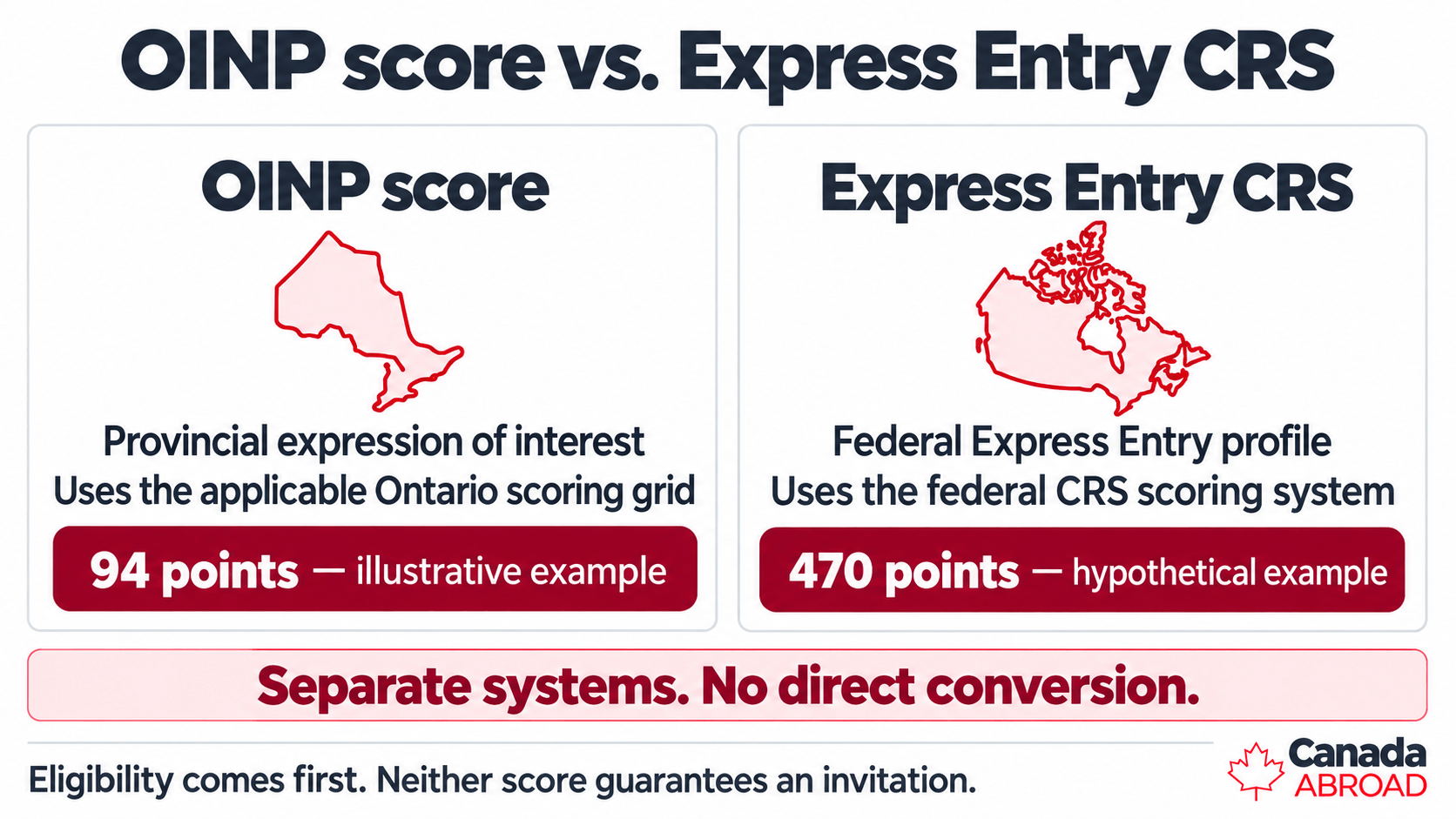
The two scores are used for different programs. Ontario’s score helps rank candidates for provincial selection; Express Entry’s CRS score ranks eligible candidates in the federal Express Entry pool.
| Question | OINP EOI score | Express Entry CRS score |
|---|---|---|
| Who uses it? | Ontario | Immigration, Refugees and Citizenship Canada |
| What does it measure? | Factors in the applicable provincial selection grid such as work experience, NOC code, and wage | Federal factors such as age, education, language, work experience, and Canadian connections |
| What should you compare it with? | An Ontario invitation round after August 4, 2026 | A relevant Express Entry draw |
| Does a high score establish eligibility? | No | No |
| Can one number be converted into the other? | No | No |
The Express Entry CRS has its own scoring rules. For example, IRCC removed CRS points for qualifying job offers on March 25, 2025, while employment-related factors still contribute points in Ontario’s current scoring system. IRCC’s CRS criteria
Does an Ontario nomination add 600 points to a CRS score?
An accepted Express Entry linked provincial nomination adds 600 points to a CRS score. A non-Express Entry linked nomination does not add any CRS points to an Express Entry profile. IRCC’s additional CRS points
Under the current Workforce Priority Stream, eligible TEER 0–3 candidates and self-employed physicians may choose the Express Entry linked option if they independently meet federal Express Entry requirements and maintain their Express Entry profile. Do not assume every Ontario nomination follows the same federal process. Ontario’s application process
How is an OINP score calculated?
OINP EOI scores are based on employment/labour market, education, language, and regionalization factors.
For an initial estimate, use Canada Abroad’s OINP Points Calculator. Check the result against the current official grid, including the October 5 earnings update.
The following example shows how several factors work together. It is an illustration, not a finding that this candidate meets every employer, job-offer, or applicant requirement.
What would a candidate’s OINP and CRS scores look like?
Imagine Asha has an independently calculated CRS score of 470. We are using that federal score as an assumption, not calculating it from the limited facts below.
For her OINP EOI, assume the following:
| Factor | Asha’s circumstances | OINP points |
|---|---|---|
| Occupational TEER | TEER 1 job | 9 |
| Occupational category | NOC broad category 2 | 6 |
| Offered wage | $32 per hour | 10 |
| Experience in the offered position in Ontario | Currently working in the offered position, with 18 qualifying full-time months in Ontario | 15 |
| Canadian earnings | $55,000 in a qualifying year, supported by a CRA assessment | 6 |
| Status in Canada | Valid work permit | 10 |
| Highest level of completed education | Bachelor’s degree | 6 |
| Canadian education | One eligible Canadian credential | 5 |
| Language proficiency | CLB 8 in all four abilities | 12 |
| Official languages | Qualifying English only | 5 |
| Job location | Ottawa, in Eastern Ontario | 10 |
| Total | Illustrative provincial score | 94 |
Asha’s OINP EOI score would be 94 using the current Workforce Priority scoring grid.
Asha’s OINP score of 94 and CRS score of 470 are both meaningful, but they cannot be compared directly. Neither score tells her, by itself, whether she is likely to receive an ITA.
How do location, wages and field of study affect the result?
Holding every other scored factor constant:
- Job location: A Toronto workplace earns zero regional points, compared with 10 for the Ottawa workplace in this example. That would reduce the illustrative total from 94 to 84.
- Wage: Increasing the illustrative offered wage from $32 to $36 per hour would increase the assigned points from 10 to 12 points.
- Field of study: The current Workforce Priority Stream does not award specific points for field of study. Asha’s highest level of education, eligible Canadian credential, and the NOC category of her job offer are distinct factors.
These comparisons illustrate the published scoring rules. Any changes to current employment in Ontario, or a job offer in Ontario, can change a candidate’s score. Any changes, or potential changes, to employment should be reviewed to assess how a candidate’s score may change.
What is the difference between OINP eligibility, points and an invitation?
Treat the process as separate decisions.
1. Do you meet the eligibility requirements?
Eligibility comes first. A strong calculator result cannot compensate for a missing mandatory requirement.
Check the current applicant, employer and job-offer requirements that apply to your pathway. Review your occupation, work experience, education, language abilities, licensing where relevant, immigration status and intention to live in Ontario. Requirements differ between pathways. Official Workforce Priority requirements
Canada Abroad’s Ontario Immigrant Nominee Program overview can help you begin identifying the relevant route.
2. Have you registered an accurate expression of interest?
An EOI is not an application for a provincial nomination. For the job-offer process, the employer initiates the offer through Ontario’s employer portal before the candidate registers their EOI.
Gather the necessary documents to support your EOI, as Ontario will require you to substantiate the points claimed in your EOI. Ontario’s application process
Application & Profile Review: check before you submit
Unsure whether your occupation, employment history or supporting evidence matches your answers? Canada Abroad’s OINP Profile Review service can help identify errors and areas needing attention before you submit your expression of interest.
If you need a complete OINP application for a provincial nomination, after receiving an invitation apply, reviewed, please contact info@canadaabroad.com.
3. Does the invitation round include your profile?
Ontario can conduct general or targeted selections. Your score matters within the group being considered, not in isolation.
An ITA allows you to apply for a provincial nomination; it is not a provincial nomination. A successful application for a provincial nomination is also separate from the federal decision on an application for permanent residence. Ontario’s selection and application process
What is a good OINP score for the next draw?
There is no score that guarantees selection. A previous cutoff tells you what happened in that particular round.
Before comparing your score with an OINP draw, check:
- Stream : Was the round for the same stream you are using?
- Targeting: Did it restrict selection by occupations, regions, or other characteristics?
- Timing: Were the same scoring factors in effect?
- Evidence: Can you support your score with the required documents?
A previously low cutoff score can be misleading when its selection criteria do not match your profile. Use Ontario’s official program updates to check current announcements to keep up to date with OINP draws.
What should you do if your OINP score is low?
Start with accuracy, then consider changes that are realistic for you.
- Check the inputs. Incorrectly entered information on your EOI could be lowering your score.
- Assess achievable improvements. Consider whether stronger language results, obtaining additional qualifying Canadian work experience, a higher skilled job offer, or a wage increase would change your score.
- Evaluate the whole pathway. A potentially higher score will not be useful if the job or employer fails to meet the stream’s mandatory requirements.
Be aware of what information can be updated on an EOI. Ontario’s current process restricts candidates from editing their NOC and hourly wage; these changes require the employer to withdraw and recreate the job offer, followed by candidates submitting a new EOI. Ontario’s profile-update instructions
Talk to an OINP expert
Book a one-on-one consultation to discuss your eligibility, your score and the provincial or federal pathways worth considering. Bring your job-offer details, employment history, education and language results so the discussion can focus on practical options.

Gopal Vashisht
Regulated Canadian Immigration Consultant
- CICC Licence R534569
- Barrie, Ontario
Gopal has over 20 years of experience in finance, operations, and immigration, establishing himself as a trusted expert. As a licensed RCIC in Ontario, Canada, he has guided numerous applicants through temporary…

Magda Zaplotny
Regulated Canadian Immigration Consultant
- CICC Licence R514390
- Mississauga, Ontario
Magda is a seasoned and versatile licensed professional. With years of experience in the Immigration industry and real estate, she has the knowledge and experience to help applicants in creating the most…

Marcia Freese
Regulated Canadian Immigration Consultant (RCIC)
- CICC Licence R708661
- Fall River, Nova Scotia
Marcia’s focus has been on the Atlantic provinces, specifically the Atlantic Immigration Program, but is proficient in all types of applications except Quebec. She has a love for immigration, Canada and helping…

Nikolay Kolev
Regulated Canadian Immigration Consultant
- CICC Licence R533573
- Toronto, Ontario
Nikolay Kolev is a regulated Canadian immigration consultant who is fully competent in all types of Canadian Immigration applications, excluding business immigration and Quebec Immigration. As a Regulated Canadian Immigration Consultant based…
Frequently asked questions
No. You must meet the applicable eligibility requirements and fall within the candidates Ontario considers in a selection round. A high score does not guarantee an invitation, nomination or permanent residence. Ontario application process
Under the current Workforce Priority stream, the TEER 0–3 and TEER 4–5 pathways require a qualifying job offer. A separate route exists for qualifying self-employed physicians. Older no-job-offer stream guides should not be treated as current application options. Current pathway requirements
No. Ontario closed the former Employer Job Offer: International Student stream in 2026. New candidates should check current pathway requirements; applications already submitted are assessed under the rules applicable at submission. Ontario’s closure and transition updates
No. Your OINP score ranks your provincial expression of interest, while CRS ranks your federal Express Entry profile. An accepted Express Entry provincial nomination adds 600 CRS points; the Ontario EOI score itself does not transfer into CRS. IRCC CRS criteria
This guide is intended for informational purposes only and does not constitute legal advice. Immigration requirements change frequently, and individual eligibility depends on your specific circumstances and the rules in force at the time of application. Consult one of our regulated Canadian immigration consultants for advice regarding your specific situation.
